AI Detector Free in 2026: Best Tools to Check AI-Generated Content
Over 165,000 people search "AI detector free" every month — trying to identify whether text was written by AI. Teachers checking student essays, editors verifying content quality, publishers screening submissions — and writers checking their own work before submission. In this guide and review, we tested and compared the best free AI detector tools in 2026 for accuracy, reliability, and practical use. We also explain when AI detection matters, when it doesn't, and the important limitations of every free AI detector available.
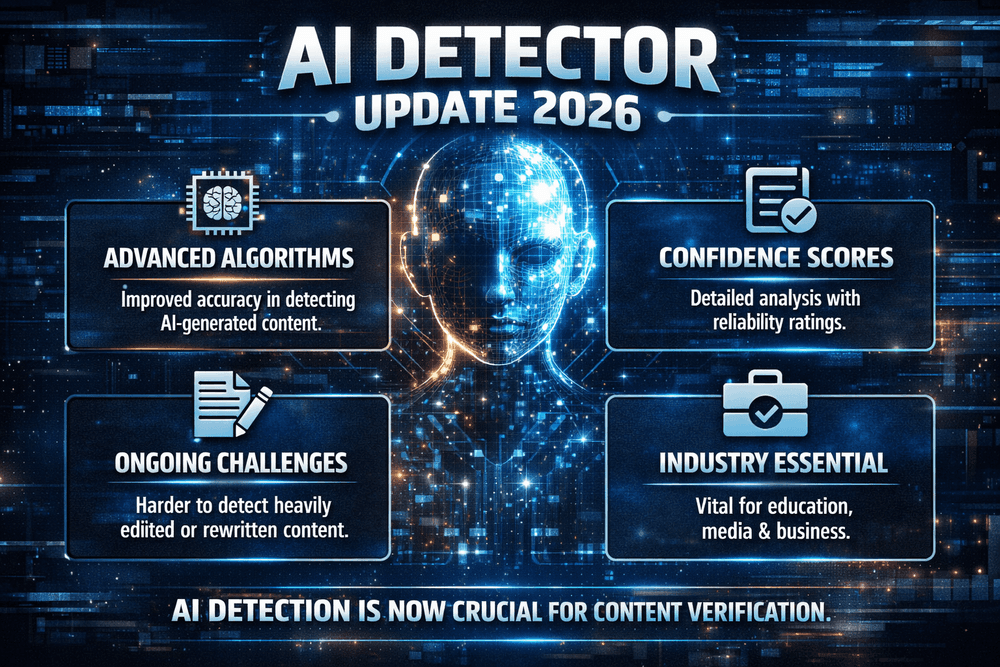
!AI detector free guide 2026 — best tools to check AI-generated content
Best Free AI Detector Tools in 2026
1. GPTZero — Best Free AI Detector for Education
GPTZero is the most widely used free AI detector for educational contexts — built specifically to identify AI-generated student work with class-level scanning features.
Why GPTZero leads for education: - Purpose-built for detecting AI-written academic content - Free tier with meaningful scanning capability - Reports perplexity and burstiness metrics - Sentence-level AI probability highlighting - Widely trusted in academic institutions
Accuracy assessment: GPTZero achieves approximately 85% accuracy on clear-cut AI-generated content in testing. Accuracy drops significantly for mixed human/AI content and for well-edited AI text. False positives (flagging human writing as AI) occur in roughly 5-10% of cases in peer-reviewed studies.
Honest limitations: No AI detector is 100% accurate. False positives flag human writers unfairly. Premium tier needed for class-wide scanning and API access.
Best for: Teachers and academic institutions checking student work for AI assistance.
2. Originality.AI — Best Paid AI Detector (Most Accurate)
Originality.AI is the most accurate AI detector available in 2026 — particularly effective at detecting content from the latest AI models including GPT-4o and Claude.
Why Originality.AI leads for accuracy: - Highest detection accuracy of any AI detector in independent testing - Detects content from all major models (GPT-4, Claude, Gemini, Llama) - Combines AI detection with plagiarism checking - Updates model as new AI systems release
Honest limitations: Not free — credit-based pricing (approximately $0.01/100 words). Premium quality comes at a cost. Free trial available for testing.
Best for: Publishers, editors, and SEO teams who need reliable AI detection with high accuracy.
3. Copyleaks — Best Free AI Detector with Plagiarism Checking
Copyleaks combines free AI detection with plagiarism scanning — the best free AI detector for users who need both capabilities in a single tool.
Why Copyleaks works: - Free tier includes AI detection and plagiarism checking - Supports multiple languages - Identifies mixed AI/human content - API available for integration
Honest limitations: Free tier has monthly scan limits. Accuracy is comparable to GPTZero — reliable for obvious AI content, less accurate for heavily edited or human-AI mixed text.
Best for: Content teams and publishers who need AI detection plus plagiarism checking in a free package.
4. Sapling — Best Free AI Detector for Quick Checks
Sapling offers a simple, fast free AI detection interface — the best free AI detector for quick one-off checks without registration.
Why Sapling works: - Fast, no-registration AI detection - Clean interface for quick checks - Sentence-level probability scores - Free for basic use
Best for: Quick AI content checks without committing to a platform.
Free AI Detector Comparison
| Tool | Accuracy | Free | Best For |
|---|---|---|---|
| GPTZero | Good | Yes (limited) | Education / academic |
| Originality.AI | Excellent | Trial only | Professional publishing |
| Copyleaks | Good | Yes (limited) | AI + plagiarism checking |
| Sapling | Good | Yes | Quick no-registration checks |
Critical Limitations of AI Detectors: What the Research Says
Before relying on any AI detector — free or paid — the limitations are important to understand:
No detector is reliably accurate. The most rigorous peer-reviewed study on AI detectors (Weber-Wulff et al., 2023) found that even leading AI detectors failed to reliably detect AI-generated content — with false positive rates high enough to wrongly flag legitimate human writing.
False positives harm innocent people. Students have faced academic sanctions based on AI detector flags of their genuinely human-written work. Non-native English speakers are particularly vulnerable to false positives — their writing patterns can resemble AI output. Multiple documented cases exist of students failing assignments based on erroneous AI detector accusations.
Paraphrasing defeats most detectors. Lightly paraphrased or reworded AI content typically passes all free AI detectors. Detection works best on unedited, directly generated AI text.
Detectors lag behind new models. As AI models improve, detection tools must constantly update. Detection accuracy for the latest models is typically lower than for older models.
The right use of AI detectors: Use them as one signal among many, not as definitive proof. Treat positive flags as reasons for further investigation, not automatic penalties.
The AI Detection Market in 2026
Data on AI detection:
- 165,000+ monthly searches for "AI detector free" — reflecting massive demand for AI content verification (DataForSEO, 2026)
- AI-generated content now represents an estimated 30-40% of web content in 2026 (industry estimates, 2025)
- False positive rates for leading free AI detectors range from 3-15% in independent academic testing — meaning 3-15 of every 100 genuinely human-written pieces may be flagged (Weber-Wulff et al., 2023)
- Educational institutions increased AI detection scanning by 340% from 2023 to 2025 (Turnitin data, 2025)
- AI detector accuracy for heavily paraphrased content drops to below 50% in testing — essentially random at that point
- The AI detection industry is projected to reach $1.2 billion by 2027 as educational and publishing demand grows (Statista, 2025)
When AI Detection Matters — and When It Doesn't
AI detection matters for: - Academic submission integrity (with appropriate caveats about accuracy) - Publisher verification of freelance content quality - SEO content quality control (AI content penalties from Google) - Legal contexts where authorship has contractual implications
AI detection doesn't matter for: - Personal creative writing and fiction — for your own use, AI assistance is your choice - Adult creative fiction — AI companion writing tools like PLEASUR AI produce intimate, personal content that you own and that no one else needs to approve - Internal business content — for internal use, AI assistance is a productivity tool, not a policy issue - Any content where the creator is transparent about AI use
For creative writers using AI as a collaborative tool for personal or adult fiction, AI detection is irrelevant. PLEASUR AI functions as an AI writing companion for intimate narratives — collaborative adult storytelling where detection doesn't apply because you're writing for yourself. Start free on PLEASUR AI.
FAQ: AI Detector Free
What is the best free AI detector? GPTZero for education (academic context, free tier). Copyleaks for combined AI + plagiarism detection (free tier). Sapling for quick no-registration checks.
How accurate are free AI detectors? Approximately 80-90% accurate for unedited AI content. False positive rates of 3-15%. Accuracy drops significantly for paraphrased, edited, or mixed human/AI content. No free AI detector is reliable enough to use as sole evidence of AI authorship.
Can AI detectors detect ChatGPT writing? Major detectors can identify some ChatGPT output, especially unedited text. Lightly edited or paraphrased ChatGPT content typically passes most detectors. Detection accuracy for the latest GPT models is lower than for older versions.
Are AI detectors accurate enough for academic use? Used carefully, yes — but not as definitive proof. Multiple academic bodies recommend using AI detection as a starting point for investigation, not automatic evidence of academic dishonesty. The false positive risk is too high for purely automated decisions.
What is the most accurate AI detector? Originality.AI achieves the highest independent accuracy scores among paid tools. Among free tools, GPTZero and Copyleaks are the most reliable, with comparable accuracy to each other.
The Bottom Line
Free AI detectors in 2026 are useful tools for identifying AI-generated content — with important caveats about accuracy limitations.
For education: GPTZero. For combined AI + plagiarism checking: Copyleaks. For professional publishing accuracy: Originality.AI (paid). For quick checks: Sapling.
For writers using AI as a creative tool for personal and adult fiction: AI detection is irrelevant to your work. PLEASUR AI provides AI companion writing for intimate narratives — the only audience that matters for personal creative content is you.